
Get Started!
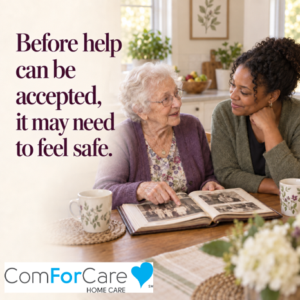
An older adult’s refusal of home care may protect privacy, routine or control. Learn how to understand the concern and introduce support without taking over.
The first conversation about home care often begins with a practical concern. A daughter has noticed that meals are being skipped. A son is worried about a recent fall. A spouse is no longer sleeping because they are listening for movement during the night. The family sees a problem that needs attention.
The older adult may hear something different. “You need help” can sound like “You can no longer be trusted with your own life.” A suggestion intended to protect safety may feel like a threat to privacy, competence or control.
That is why a quick answer such as “I do not need help” should not automatically end the conversation or become the start of an argument. Refusal may be protecting something that has not yet been named.
Long before anyone began discussing caregivers, the person made decisions about work, family, money, relationships, routines and home. They solved problems in their own way. They chose what they would accept and what they would not. Growing older does not erase that history.
When a family begins arranging appointments, checking the refrigerator or talking about a caregiver, the older adult may feel that decisions are being made around them rather than with them. Even kind and necessary help can feel intrusive when it arrives without enough explanation or choice.
Person-centred care starts from the understanding that the individual remains a person with a history, preferences and a right to participate in decisions. The Alzheimer Society of Canada describes this approach as care that recognizes each person’s values, personal history and individuality while creating respectful partnerships among the person, family and care team.
The words may be brief, but the concern behind them may be specific. “I do not need help” can mean:
Families cannot respond well until they understand which concern is present. Repeating the benefits of home care will not resolve a fear of losing control. A list of safety risks will not build trust with someone who is worried about having a stranger in the house.
Names and identifying details have been changed to protect privacy.
During one home assessment, a daughter warned that her 95-year-old mother refused assistance from anyone outside the family. The family expected the conversation to be difficult. Instead of beginning with a checklist of limitations, the assessor noticed a photo album and asked about the people in it.
The older woman became the person leading the conversation. She described the photographs, the family history and the life represented on those pages. The assessment took longer than a standard list of questions, but the time was not wasted. It allowed the older woman to decide who this visitor was and whether she felt respected in her own home.
The family arranged support that day. Care began with two consistent caregivers and expanded gradually as needs changed. Years later, after a move to a retirement residence, a familiar caregiver continued visiting weekly. The first success was not a completed household task. It was the beginning of trust.
Not every conversation will end that way, and a photo album is not a technique that works for everyone. The useful principle is broader: learn what matters to the person before asking them to accept a change in their life.
A conversation usually goes better when it begins with the person’s goals rather than the family’s list of concerns. Ask what they want their days to look like. What do they want to keep doing themselves? Which routines matter most? What would make it easier to remain at home?
A person who rejects “home care” may be willing to accept help with one specific task that supports a valued goal. Someone may refuse a caregiver but welcome a companion for grocery shopping. Another person may accept help preparing lunch because it leaves enough energy for an afternoon walk. A spouse may agree to nighttime support because both partners want to continue living together at home.
The language matters because the plan matters. If the service is introduced only as supervision, the person may hear surveillance. If it is connected to something they value, they can see what the support protects.
Families can reduce resistance by making the first step smaller and more predictable.
A respectful approach does not guarantee immediate agreement. It creates a better chance of hearing the real objection and finding a form of help the person can live with.
Pressure often rises when families speak in conclusions. Questions can create more room for the person to participate.
| Approach | Example wording |
| Instead of | You cannot keep doing this alone. |
| Try | Which part of the day has become the most tiring? |
| Instead of | We have already arranged a caregiver. |
| Try | Would you prefer someone to come in the morning or after lunch for the first visit? |
| Instead of | You are not safe here anymore. |
| Try | What would help you feel safer while staying in your home? |
| Instead of | You need someone watching you. |
| Try | Would some help with meals and laundry leave more time for the things you want to do? |
The purpose of these questions is not to disguise a decision the family has already made. They should be genuine choices wherever possible. People recognize when participation is only being performed.
A person’s preference deserves respect. The family’s observations also matter. Missed meals, falls, medication confusion, unsafe driving, wandering, an unattended stove or repeated emergencies cannot be solved only by avoiding a difficult conversation.
Keep a factual record of what is happening. Write down dates, observable changes and consequences without exaggeration. Bring that information to the person’s health-care professional or another appropriate professional. Sudden confusion or a rapid change in behaviour requires prompt medical assessment. Call 911 when there is immediate danger or a medical emergency.
Refusing help by itself does not establish that someone is unable to make decisions. When there are concerns about decision-making ability, seek appropriate medical and legal guidance rather than making assumptions based on age or diagnosis.
Unless the situation is urgent, a refusal does not always require another argument that same day. Leave the conversation respectfully and return to it with a narrower proposal. A family may also ask a trusted physician, friend, faith leader or care professional to join the discussion, provided the older adult is not being surrounded or pressured.
Meanwhile, look for changes the person is willing to accept. Meal delivery, transportation, a housekeeping visit, a medical alert system or a companion outing may reduce one pressure and create familiarity with support. These measures are not substitutes for necessary personal care or supervision, but they may be a workable beginning.
The strongest care plan is not simply the one a family can arrange. It is the one that responds to current needs while preserving as much voice, routine and independence as possible.
Home care often becomes acceptable when the person can see that it is helping them continue their life rather than taking that life over. The caregiver arrives at an agreed time. The person knows what the visit is for. They continue doing what they can. The family receives a more reliable safety net, and the older adult remains central to the plan.
Before help can be accepted, it may need to feel safe.
If your family is unsure how to begin, ComForCare Halton can meet with you and your loved one for a complimentary in-home assessment. The conversation can focus on present needs, preferred routines and the smallest useful starting point. There is no need to wait for every decision to become urgent.
General information notice: This article provides general educational information and is not medical, legal or emergency advice. Call 911 for immediate danger or a medical emergency. Speak with appropriate health-care or legal professionals about concerns involving sudden changes, decision-making ability or serious safety risks.









Each office is independently owned and operated and is an equal opportunity employer.
ComForCare strives to provide services accessible to everyone, please contact your local office for documents and details related to accessible Customer Service.
© 2026 ComForCare Franchise Systems, LLC.