
Get Started!
See how professional companions can use attentive conversation, familiar activities and respectful notes to support a person’s choices during everyday visits.
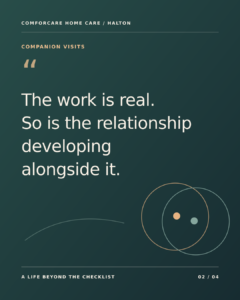
A companion may arrive with several things to do: make lunch, help with an outing, tidy a room and note how the visit went. The work is real. So is the relationship developing alongside it.
Imagine that a client pauses at a shelf of framed photographs while the companion prepares the table. “That was the first house we bought,” she says. The companion can acknowledge the remark and ask whether she would like to say more. If she does, the conversation might reveal that she loves setting a table for company. The next visit could include choosing the plates together. If she does not, lunch continues. No one has failed.
This is narrative care in its everyday form: noticing what a person offers, listening without taking over and letting their preferences inform what happens next. The scene above is illustrative, not an account of an actual client.
Before the visit, learn the person’s stated interests and routines from the approved care plan and the person herself. Do not assume that a hobby listed years ago still appeals to her today.
During a familiar activity, offer a modest opening: “Would you like to put on some music while we work?” or “You mentioned growing tomatoes—did you always enjoy gardening?” Sensory cues can be useful when the person welcomes them, but a song, scent or photograph may also carry difficult memories. Watch the response and change course when needed.
Make room for present-day identity. Ask what the person wants for lunch, which route she prefers for a walk or whether she would rather talk or sit quietly. A life story is more than a collection of events from long ago.
After the visit, record care information through the agency’s authorized system, following the care plan and documentation requirements. If a preference matters for future visits, a concise note such as “Client said she enjoys choosing music while preparing lunch; ask her preference each time” may help the team. A private disclosure is not automatically something to enter in a shared record. Keep care notes factual, relevant and limited to what the team needs to provide support.
A companion is there to offer presence and practical support, not to conduct therapy or extract a life history. Some stories involve grief, estrangement or trauma. Acknowledge what was shared, let the person decide whether to continue, and follow the agency’s escalation procedures when a safety or care concern arises. Do not promise secrecy that conflicts with those duties.
Recording a voice, photographing a keepsake or preparing a memoir is a separate project. A companion should not start it on a personal phone or share material through a personal account. The person, the family where appropriate and the agency need a clear agreement about purpose, consent, storage and access before any recording begins.
The lunch was prepared and the outing took place. The person also chose the music, explained why one recipe matters and decided what she wanted to do next week. Those details do not replace the practical record; they help make the next visit more recognizably hers.
Gentle close: Families choosing companion care can ask how an agency learns a person’s preferences and how that understanding is carried respectfully from one visit to the next.
Next in the series: When a person wants to preserve stories, an audio recording can become a carefully edited digital memoir.









Each office is independently owned and operated and is an equal opportunity employer.
ComForCare strives to provide services accessible to everyone, please contact your local office for documents and details related to accessible Customer Service.
© 2026 ComForCare Franchise Systems, LLC.